Goodbye BEMM129: Final Reflection

https://youtu.be/5K-IIeKIrJ0
https://marketing.prowritingaid.com/link%20building.jpg

Reading and commenting on the blogs of other learners constitute numerous advantages for any learner. Blogs have been increasingly becoming a great platform for obtaining any information and discussing it (Walker, 2007). Over the course of this module, we had been provided with multiple opportunities to learn from writing blogs, reading relevant information and posting valuable comments on the posts of other learners. Through the blog post on the changing role of a specific job in the digital economy, I got to learn about different interest areas of colleagues with regard to their views on the impact of digitization on various career opportunities and job roles. Reading the posts of other learners helped me in enhancing my existing knowledge of specific job roles and ideas through which I could improve upon my own blogs. For instance, I learned that long paragraphs in blog writing can be uninteresting for the readers and using more pictures, graphs, charts, etc. engages the readers. Commenting about valuable insights relevant to the blog of others helps in establishing a connection between all the fellow learners, be it within the university or the entire MOOC community. Posting valuable comments depict the engagement of the readers in the content of the blog and enhance the probability of them to read another blog of ours.


https://www.animatedvideo.com/blog/wp-content/uploads/2017/05/Increase_Engagement_with_Online_Video_Animation-770×360.jpg

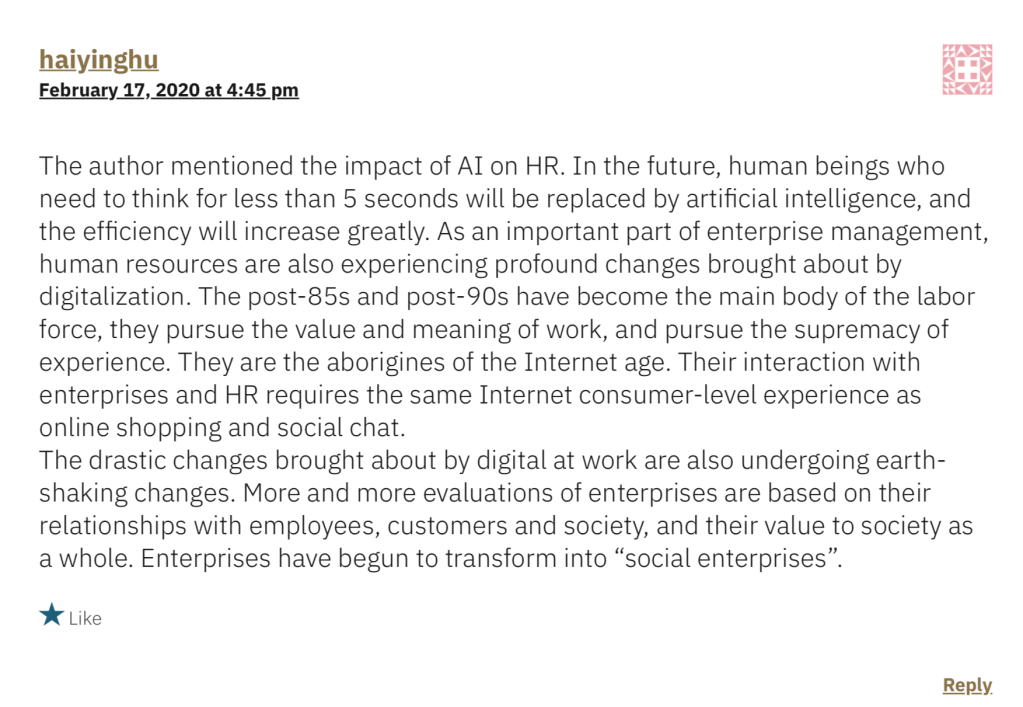
Readers’ engagement is one of the crucial factors that measure the efficacy of the content of a blog. If we post a comment that adds value to the blog, the blogger might as well want to find your blog and post a comment if they wish to do so. Initially, I was unaware of the importance of reading and commenting on the blog posts of others within the university and the entire MOOC community. It provides the opportunity to connect with bloggers from across the world and understanding their perception, as argued by Sabbagh et al. (2013), the impact of digitization is uneven on different nations. However, I learned how to post effective blogs and create engaging content. For instance, in the week 3 blog, I replied to the blog posts of other students who provided some useful insights into the changing roles of different career paths in the digital economy and added to my existing knowledge of the specific job roles.
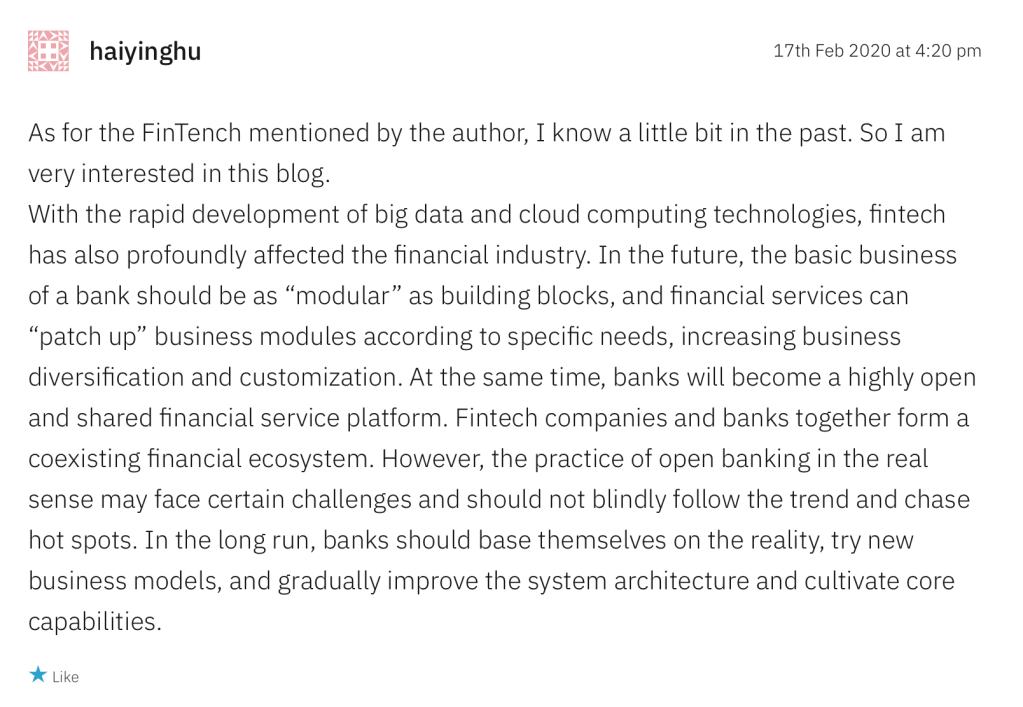
https://digitalbusinessmodels.design.blog/2020/02/14/the-fintech-revolution/
https://jacquelinelaiphotography.photo.blog/2020/02/13/how-has-digital-economy-transformed-the-role-of-human-resource-personnel/
https://digitalmodelexeteralexis.business.blog/comment-page-1/?unapproved=2&moderation-hash=d2fa65bd0a504b2297d847e8fffe72b8#comment-2
https://wangsiyun.design.blog/2020/03/06/tiktok-the-rise-of-creative-social-media/comment-page-1/?unapproved=5&moderation-hash=ddc26c0c246ce5f61e8f9
https://benleahydigitalmodels.business.blog/2020/03/05/amazons-successful-digital-business-model/comment-page-1/?unapproved=1&moderation-hash=516e0

Furthermore, I recognized that one must not post negative comments if not agreeing with the content, rather one should post constructive comments that can be taken positively by the content creator. Overall, reading and commenting fosters the engagement of the reader and helps to build a relationship with the entire community of bloggers that can be profitable in the long run who aspire to be a content creator in the future. Moreover, I will learn to utilize technology for effective digital business processes. Understanding the concepts and role of digitization has also helped me gain ideas for dissertation topics such as effective use of social media for digital business, how to utilize technology for boosting the engagement of the targeted audience, etc. I will inculcate my learnings from reading and commenting on blogs in my upcoming blogs by creating valuable content and developing my digital professional profile for the digital content creator in the future.

References

Sabbagh, K., Friedrich, R. O. M. A. N., El-Darwiche, B. A. H. J. A. T., Singh, M. I. L. I. N.

D., & Koster, A. L. E. X. (2013). Digitization for economic growth and job creation: Regional and industry perspective. The global information technology report2013, 35-42.

Walker, D. M. (2006). Blog commenting: A new political information space. Proceedings of the American Society for Information Science and Technology43(1), 1-10.

Digital Business Model

Uber: The Success Story

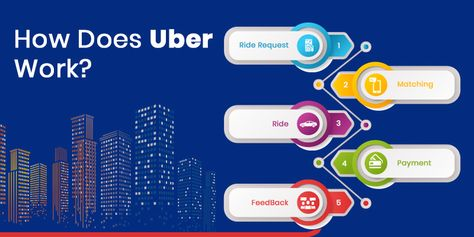
Uber is one of the fastest-growing ride-hailing companies that offer various services like ride-sharing, ride-hailing, delivery of food and micro-mobility services with lightweight vehicles like scooters and bikes. The company was established in the year 2009 and has its headquarters in San Francisco, California. The digital business model of Uber has been one of the major factors contributing to its success. Evaluation of the market value of digital marketplaces like Uber highlights the current attractiveness of digital business models to the investors (Tauscher, 2016). Uber has made it easier to cover a distance for the consumers without having them to use their own transport. Consumers can use the Uber app to book a ride and other services without any hassle.

The digital business model of uber suggests that it addresses the most common issues of the consumers with the traditional way of transportation in the context of booking taxis including hassle in taxi bookings, higher fares, if the driver of the taxi is trustworthy or not, cash only mode of payment and so forth. Another important benefit that can be observed from the working process is that it creates opportunities for the car owners with all the verified documents for driving to earn an additional amount of money by driving.

https://i.pinimg.com/474x/5f/ff/b7/5fffb7374c59057b6856f4d45ca12a89.jpg

Uber provides all the necessary information that may be required by the users via its app which serves as a digital platform to have access over every detail. For the convenience of users, the Uber app can be downloaded from the app stores in smartphones, tablets, etc by the android or IOS users. This has helped the company in increasing its reach and accessibility among potential users worldwide. The existing users of Uber provide ratings on the app stores that attract other individuals to use these services and also help the company in improving its services through the feedback of its users.

https://www.businessmodelsinc.com/wp-content/uploads/2018/11/Uber-1024×576.jpg

The digital business model of Uber has been effective in increasing awareness about the company among the targeted users. Whenever a person books an Uber ride with a friend or relative who is non-users of Uber, they become aware of the Uber services (Tauscher, 2016). Consequently, the possibilities of positive word of mouth increase and thereby brand awareness among the potential users also increases. Furthermore, uber tries to improve its services as per the feedback of consumers. The network of drivers is strongly connected, and the route map used by the drivers to reach the destination has been improved through its digital business model.

The digital business model has helped the company in growing substantially in the last decade. According to Isaac and Davis (2014), observations from the digital business model of Uber signifies that the success of Uber is dependent upon the following three conditions:

  1.  Uber has efficiently distinguished itself as a technology company rather than a transportation company that also helped uber in getting exemptions from the costly laws and regulations related to the usage of the taxi.
  2. The company treats its drivers across the world as independent contractors rather than the employees of the company. This allows the company to avoid the protections or perks assured to the employees as per the standard relationship of employees and employers that can be a costly affair for the company.
  3.  It creates a poor labor market in which the drivers are prepared to deal with the burden of risks associated with the job and costs related to it.

The success of Uber in the market indicates that the company has effectively demolished the monopoly of taxi drivers in the cities and shifted the risks and associated costs onto the drivers or employees. According to Uber, it is nearly doubling the revenue of the company every 6 months (Isaac & Davis, 2014). Uber also offers various kinds of discounts on payments and also gives ride pass to the users which allows them to pay a convenient sum of money before and pay the rest of the amount later. They have also taken various measures to ensure the safety of users while taking a ride on Uber. Users can add their trusted contacts on the Uber app and these contacts can track the location of their loved ones while they are on ride.

https://cdn.pocket-lint.com/r/s/970x/assets/images/139559-cars-news-feature-what-is-uber-and-how-does-it-workimage1-hqo61ckvv9-jpg.webp?v1

Uber has an excellent marketing strategy that is cost-effective and attracts users easily. In order to travel a distance, using transportation is inevitable for people and therefore the change brought by Uber in providing affordable Uber ride in place of costlier taxi rides is noticeable. Therefore, it can be said that the digital business model of Uber has helped the company in maximizing its profit and reducing the risks and costs by strategically shifting some part of the costs and risks on the employees.

References

Isaac, E., & Davis, U. C. (2014). Disruptive innovation: Risk-shifting and precarity in the age of Uber (p. 7). Berkeley Roundtable on the International Economy [University of California, Berkeley].

Tauscher, K. (2016). Business Models in the Digital Economy: An Empirical Classification of Digital Marketplaces. Fraunhofer Center For International Management and Knowledge Economy.

A Career Path: Chief Information Officer (CIO) and the ways it has changed in the Digital Economy

Source: https://www.behaviour-group.com/PT/changing-role-chief-information-officer-cio/?lang=en

Digitization has been increasingly transforming the corporate world, changing every part of the business and its processes. It is therefore quite evident that the role of CIO has evolved over the last decade. The CIO is responsible for formulating strategies related to technology and is the senior-most technology executive within an organization.

The position and requirement of CIO in organizations appeared in the 1970s due to the growing importance of Information Systems in the domain of business. The position of CIO has been generally understood as a position of rescue in any business and assumes the responsibility of coordinating business with technological paraphernalia from the period of the 1980s onwards (Gottschalk, 2012).

In the beginning, the position of CIOs was labelled as businessmen primarily, then managers, and lastly as technologists. Many a time, CIOs are confused as the general managers in companies as these designations have numerous similarities in them. However, there are certain differences between these roles as the CIO is not only responsible for the issues that most managers encounter but also being the chief strategist of the Information Systems (IS) in organization, has a set of responsibilities that must be in accordance with the information needs of the organization and evolving Information Systems (Gottschalk, 2012).

The increasingly digitizing economy has begun to indicate signs of distress for the CIOs. Due to the growing number of line managers having decent computer literacy, there might be redundancy of work as the responsibilities of CIOs and line managers may get repetitive to some extent (Ross & Feeny, 1999). This may pose a threat to the position of CIOs and their requirement in the digitized economy. However, the key issues faced by the Information Systems management within organizations overtime with the evolvement of technology have made the role of CIOs more important. These issues, as discussed by Gottschalk (2012) include improving connections between the strategies of IS and business plans, and planning projects related to IT for achieving competitive advantage. Presently, organizations are necessarily dependent on utilizing IT systems as without them, only a few could sustain in the business world (Peppard 2010). Thus, it would not be wrong to assert that the role of CIOs has become more important in the digitized economy and also expected to grow further in the future.

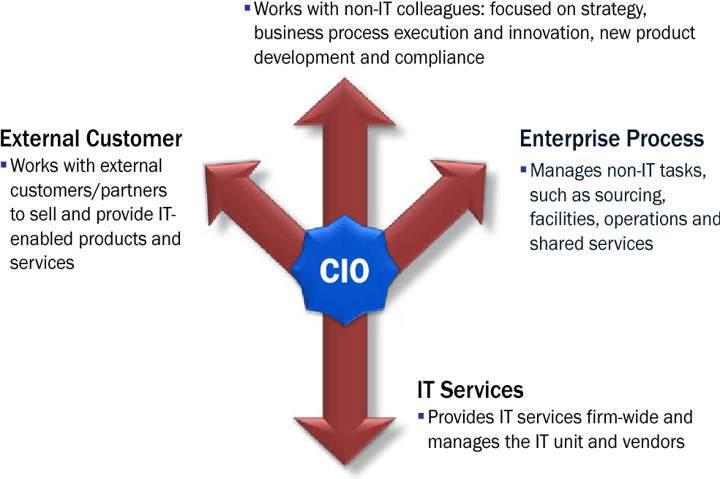
With a view to better understand the role of CIOs, it is vital to know the key activities they perform. According to Weill and Woerner (2013), CIOs spend most of their time in the following four key activities:

  • IT services activities
  • Embedded activities
  • Organizational process activities
  • External buyer activities

Source: https://www.semanticscholar.org/paper/The-Future-of-the-CIO-in-a-Digital-Economy-Weill-Woerner/ec63abb3a14ad8f9c55d332c60f71378bd0f7487

The position and role of CIOs will demand additional responsibilities in the future. In order to meet the IT demands in future, as suggested by Maffe (2017), the CIOs will have to undertake entrepreneurial roles for which they will become responsible for three major factors of scarcity in organizations including:

  • Capital- CIOs will need to be prepared for managing the exchange of financial capital such as loans and advances, credits and payments within the organization. This will also require participating in the establishment of new blockchains with a view to facilitating supportive and digital evidence of work for every financial transaction. 
  • Labour– the role of CIOs will also involve achieving maximum productivity from the existing human labour utilizing IT as well as to substitute human labour with the labour that is software-defined to the extent possible.
  • Trust- The CIOs might need to engage in renegotiation activities to protect the investments that are specific to the relationship with other parties. This will increase the chances of rebuilding the relationship and in managing the incomplete contracts.

Apart from these, CIOs will have to play their role as Market Makers, become a Fast CIO and learn strategic management of time. The role of the CIO as a market maker will require managing both the demand and supply aspects in order to prevent the information and organizational irregularities and meeting the organizational information needs and gain a competitive advantage in the corporate world.  Further, CIOs will require to become ‘fast’ in the sense that they inculcate the essence of the term by delivering timely results, being quick as well as flexible as per the digital changes (Maffe, 2017).  Adopting as per the technological and organizational needs can only be achieved through managing the time strategically. This will not only help to improve the overall performance of the CIOs but also will help the organizations in achieving economies of scale and competitive edge in the market before other counterparts.

References

Gottschalk, P. (2002, January). The chief information officer: a study of managerial roles in Sciences (pp. 3133-3142). IEEE. Norway. In Proceedings of the 35th Annual Hawaii International Conference on System.

Maffè, C. A. C. (2018). Future of the CIO: Towards an Enterpreneurial Role. In CIOs and the Digital Transformation (pp. 61-68). Springer, Cham.

Peppard, J. (2010). Unlocking the performance of the chief information officer (CIO). California Management Review52(4), 73-99.

Ross, J. W. & Feeny, D. F. (1999). The evolving role of the CIO. Massachusetts Institute of Technology.

Weill, P. & Woerner, S. L. (2013). The Future of the CIO in a Digital Economy. MIS Quarterly Executive12(2), 65-75.

Haiying Hu — Self-introduction

Welcome to my blog. I am Haiying, from Huangshan City, Anhui Province, China. My hometown is very beautiful. I am a graduate student in International Business at the University of Exeter Business School. My hobbies are painting and traveling. My personality is calm and restrained, and I am careful and pragmatic. I also have a team spirit and am good at challenging myself.

自我介绍(示例文章)

这是一篇示例文章,最初作为 Blogging University 的组成部分发布。报名参加我们十个项目中的其中一个,立即开始撰写您的博客。

您今天要发布一篇文章。不必担心您的博客的外观。如果您还没有给博客命名或是感到不知所措,也不必担心。只需点击“新文章”按钮,告诉我们您来此处的原因。

为什么要这样做?

  • 因为它能为新读者提供背景信息。让他们了解您是做什么的,他们为什么应该阅读您的博客。
  • 因为这将帮助您专注于自己对博客的想法,以及您想用博客来做什么。

文章可短可长,可以是对您的生活的个性化介绍或是博客宗旨说明,也可以是对未来的宣言或是对希望发布的内容类型的简要概述。

为了帮助您开始撰写,不妨思考以下几个问题:

  • 您为什么要公开写博客,而不是写个人日记?
  • 您认为您会写些什么话题?
  • 您想通过博客和谁联系?
  • 如果您的博客成功写到明年,您想要达到什么目标?

您并非一定要受此限制,博客的一个奇妙之处在于,随着我们学习、成长和与他人互动,它们是会不断演变的,不过如果知道从何处入手以及为何开始,这将会颇有益处,并且明确您的目标可能会激发您写其他一些文章的灵感。

不知道如何开始?只需写下您脑海中闪现的第一件事即可。Anne Lamott 是一位作家,大家都喜欢她写的书。她指出,你要允许自己写出“蹩脚的初稿”。Anne 提出了一个很好的观点,先开始写,之后再去考虑如何编辑。

在您准备发布时,给您的文章贴上三到五个标签来描述您博客的关注点 – 写作、摄影、小说、育儿、美食、汽车、电影、体育等。这些标签将帮助关注您话题的人在阅读器中找到您。确保添加“zerotohero”标签,这样其他新博主也可以找到您。

Design a site like this with WordPress.com
Get started