
Source: https://www.behaviour-group.com/PT/changing-role-chief-information-officer-cio/?lang=en
Digitization has been increasingly transforming the corporate world, changing every part of the business and its processes. It is therefore quite evident that the role of CIO has evolved over the last decade. The CIO is responsible for formulating strategies related to technology and is the senior-most technology executive within an organization.
The position and requirement of CIO in organizations appeared in the 1970s due to the growing importance of Information Systems in the domain of business. The position of CIO has been generally understood as a position of rescue in any business and assumes the responsibility of coordinating business with technological paraphernalia from the period of the 1980s onwards (Gottschalk, 2012).
In the beginning, the position of CIOs was labelled as businessmen primarily, then managers, and lastly as technologists. Many a time, CIOs are confused as the general managers in companies as these designations have numerous similarities in them. However, there are certain differences between these roles as the CIO is not only responsible for the issues that most managers encounter but also being the chief strategist of the Information Systems (IS) in organization, has a set of responsibilities that must be in accordance with the information needs of the organization and evolving Information Systems (Gottschalk, 2012).
The increasingly digitizing economy has begun to indicate signs of distress for the CIOs. Due to the growing number of line managers having decent computer literacy, there might be redundancy of work as the responsibilities of CIOs and line managers may get repetitive to some extent (Ross & Feeny, 1999). This may pose a threat to the position of CIOs and their requirement in the digitized economy. However, the key issues faced by the Information Systems management within organizations overtime with the evolvement of technology have made the role of CIOs more important. These issues, as discussed by Gottschalk (2012) include improving connections between the strategies of IS and business plans, and planning projects related to IT for achieving competitive advantage. Presently, organizations are necessarily dependent on utilizing IT systems as without them, only a few could sustain in the business world (Peppard 2010). Thus, it would not be wrong to assert that the role of CIOs has become more important in the digitized economy and also expected to grow further in the future.
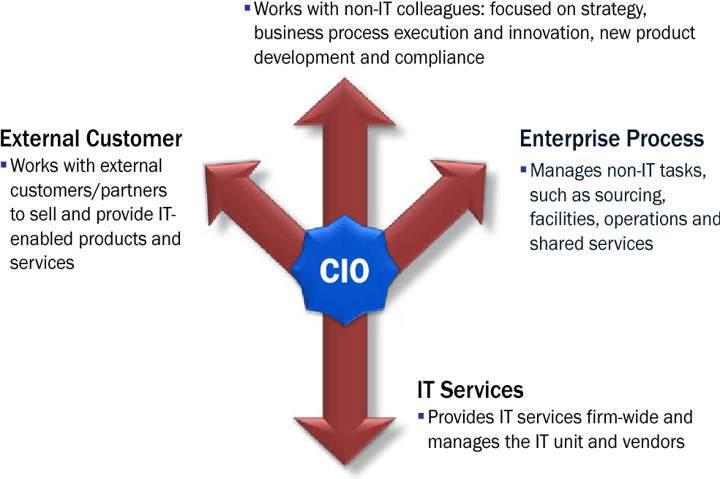
With a view to better understand the role of CIOs, it is vital to know the key activities they perform. According to Weill and Woerner (2013), CIOs spend most of their time in the following four key activities:
- IT services activities
- Embedded activities
- Organizational process activities
- External buyer activities
The position and role of CIOs will demand additional responsibilities in the future. In order to meet the IT demands in future, as suggested by Maffe (2017), the CIOs will have to undertake entrepreneurial roles for which they will become responsible for three major factors of scarcity in organizations including:
- Capital- CIOs will need to be prepared for managing the exchange of financial capital such as loans and advances, credits and payments within the organization. This will also require participating in the establishment of new blockchains with a view to facilitating supportive and digital evidence of work for every financial transaction.
- Labour– the role of CIOs will also involve achieving maximum productivity from the existing human labour utilizing IT as well as to substitute human labour with the labour that is software-defined to the extent possible.
- Trust- The CIOs might need to engage in renegotiation activities to protect the investments that are specific to the relationship with other parties. This will increase the chances of rebuilding the relationship and in managing the incomplete contracts.
Apart from these, CIOs will have to play their role as Market Makers, become a Fast CIO and learn strategic management of time. The role of the CIO as a market maker will require managing both the demand and supply aspects in order to prevent the information and organizational irregularities and meeting the organizational information needs and gain a competitive advantage in the corporate world. Further, CIOs will require to become ‘fast’ in the sense that they inculcate the essence of the term by delivering timely results, being quick as well as flexible as per the digital changes (Maffe, 2017). Adopting as per the technological and organizational needs can only be achieved through managing the time strategically. This will not only help to improve the overall performance of the CIOs but also will help the organizations in achieving economies of scale and competitive edge in the market before other counterparts.
References
Gottschalk, P. (2002, January). The chief information officer: a study of managerial roles in Sciences (pp. 3133-3142). IEEE. Norway. In Proceedings of the 35th Annual Hawaii International Conference on System.
Maffè, C. A. C. (2018). Future of the CIO: Towards an Enterpreneurial Role. In CIOs and the Digital Transformation (pp. 61-68). Springer, Cham.
Peppard, J. (2010). Unlocking the performance of the chief information officer (CIO). California Management Review, 52(4), 73-99.
Ross, J. W. & Feeny, D. F. (1999). The evolving role of the CIO. Massachusetts Institute of Technology.
Weill, P. & Woerner, S. L. (2013). The Future of the CIO in a Digital Economy. MIS Quarterly Executive, 12(2), 65-75.
 HAIYING HU
Thanks for your informative piece about the change of the CIO role in the digitising economy. You mentioned that the “responsibilities of CIOs and line managers may get repetitive to some extent” but do not explain why this is the case as a result of the “growing number of line managers have decent computer literacy” – what specific tasks do you indicate as being repetitive and why is that? An interesting perspective I read about the role of the CIO in the future highlighted the expanding activities from just the provision of IT services to encompass external customer responsibilities as well as collaborating with other departments (Weill and Woerner, 2013), which shows how the role of the CIO has expanded as a result of the digital economy. This might be interesting in terms of how the CIO is engaging with a wider range of stakeholders compared to before.
LikeLiked by 1 person
I really appreciate your point. Glad to hear from you.
Regarding the differences between CIOs and IT managers, and IT directors, the professional capabilities of IT managers are closer to the business, and IT directors need more comprehensive coordination and integration of resources. However, as a CIO, we must explore industry resources, cross-border links with more people, and cooperate in innovation.
Managers need good computer literacy because they can improve the management efficiency of an enterprise and establish an enterprise office automation system that includes multiple subsystems. Including the informationization of the entire business process, from purchasing, inventory, sales to customer management.
Regarding the connection and interaction between the CIO and the stakeholders you mentioned, I think it is a great proposal. I think the CIO is a bridge in the network. The CIO not only understands the company’s business problems, but also has a good relationship with the leaders of the company’s main business operating units, and can also assume the heavy responsibility of being a member of the company’s leadership. There is no doubt that CIOs will play an important role in using information technology to enhance the competitiveness of enterprises.
LikeLike
As most companies are influenced greatly in the digital economy, the role of many positions changed accordingly. This blog focuses on the role of CIO, because it plays a critical role in modern companies that want to achieving economies of scale and competitive edge. I have to acknowledge that through reading this blog, I can make a difference from managers and CIO. In most cases, CIO is regarded as businessmen primarily, then managers, and lastly as technologists. However, based on the most fundamental introduction of CIO, I still cannot figure how digitalization posed a threat to the position of CIOs and their requirement. Indeed, the key issues faced by the Information Systems management within organizations overtime with the evolvement of technology develop quickly, but I do not understand how that can make made the role of CIOs more important. If a typical case is referred here, we can have a better glance of the new requirements for CIOs and their importance.
LikeLiked by 1 person
With the in-depth development of digital business, the working connotation and extension of CIO are changing. The positioning of CIO by enterprises has changed from a delivery type to an operation type combining IT and business. CIO are increasingly expecting digital business. The expansion of digital business has promoted the change of CIO work. Growth is the top priority of the business. CIO must be integrated into the digital business of globalization and market share expansion of the enterprise.
Digital business is gradually reshaping the structure of products, services, industries, etc. CIO must continue to promote and change outdated work models through digital construction. CIO need to develop strategies to adapt to emerging technologies, expand digital business, and focus on business impact factors and business returns factor. As IT budget growth slows down and the mix of IT spending is more cautiously allocated, traditional IT spending should be optimized so that more funds can be invested in emerging digital technologies, moving from traditional operations and maintenance to the direction of digital business expansion.
For example, Tesco PLC, a supermarket chain, collects data on 7 million refrigerators in its data warehouse. The CIO analyzes these data, conducts more comprehensive monitoring and performs proactive maintenance to reduce overall energy consumption.
LikeLike
Haiying, this blog post has offered an excellent synopsis of the role of CIO under digital transformation, where the image of the CIOs’ roles and the bullet points of CIOs’ additional responsibilities have clearly manifested the ideas and helped me to better comprehend the full picture. however I personally think that it would be better if you could’ve included a more comprehensive comparison between CIOs’ conventional roles and transformed roles. Furthermore, the part of redundancy of work of CIOs and line managers particularly aroused my interest and prompted me to relate that to other job roles, such as recruiters, consultants or marketing executives, where some of their job functions are also being replaced by technologies. Lastly, perhaps could you express your opinions on how digitalization will continue posing challenges to CIOs and how they are going to overcome that?
LikeLike
It is clear that digitalisation has changed numerously jobs over the world. After read about your essay, I had known more about the role of CIO. At the beginning, I was quite confused how and what do digital affect CIO, however, then I found that digital can help the data more detail, accurate, and fast after read the comments below. The technology boost convenience from this section. On the other hand, this may also influence CIO’s work content because of the repeatability between both sides, which lead CIO have to change purposes for the project.
But I’m still little confuse about why digitalisation can help CIO becoming an important role of corporations? Is that CIO could be the role of communication and be the bridge of the company and the consumers? Due to high-tech is hard to communicate directly with other shareholders or customers.
LikeLike